Previously: A visitor choosing a farewell flower picked an orange stem because it made his own words easier to say. After closing, Rose and Gerbera found that a fold might divide the variety name on the thirty-year-old order slip.
At 6:40 in the morning, numbers reached the Flower Calendar Editorial Room before the flowers did.
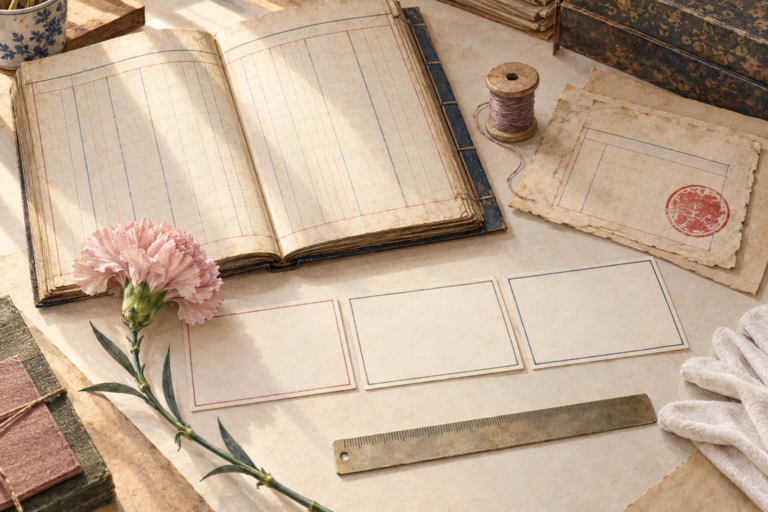
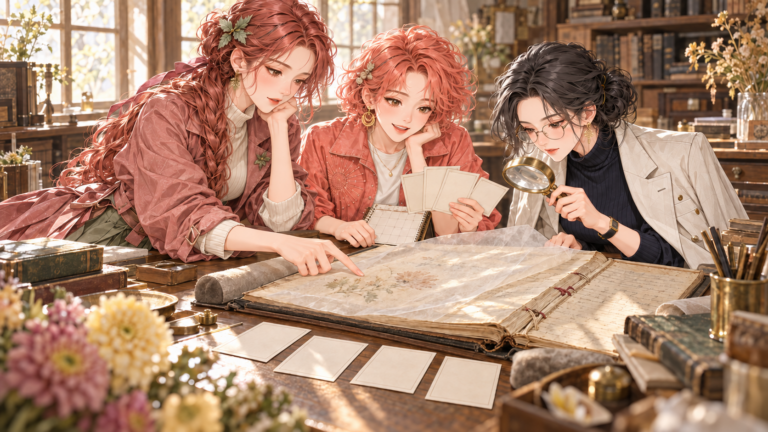
Gerbera arranged old market documents by year and joined the marks on either side of the fold in several different ways. Whenever she found a similar item name, she placed a color card beside the screen.
“Three candidates. We might have something for the noon article.”
Rose studied the order slip through its clear protective sleeve. Only the red stamp—Paid—looked unwilling to fade with the thirty years around it.
“Someone who remembers the period may contact us.”
“Headline: ‘Searching for a lost flower from thirty years ago’?”
“It’s too early to call it lost.”
The quiet correction came from the entrance.
A woman in an ink-blue jacket stepped inside, removing white archive gloves. This was Kiku, the Editorial Room’s verification editor. Narrow tabs protruded from the old document box under her arm.
“A similar name in the market record is a lead. That’s as far as we can go. If we say the same name was written on the slip, that becomes a conclusion. There is still a gap between the two.”
Gerbera turned the three cards face down.
“Did you come this early just to stop an article?”
“I’m not stopping something already published. I’m saying we aren’t ready to start writing it.”
Kiku took out a copy of a ledger used by the Editorial Room thirty years earlier. Under each date, it listed shops visited, records checked, and questions left unresolved. The unresolved boxes had not been filled. Each was marked unconfirmed in vermilion pencil.
“One volume for flowers, one for cut flowers, and three just for chrysanthemums. Classification is where the search begins.”
“That entrance has a very deep hallway,” Gerbera said.
Kiku silently added another volume.
Before noon, a woman arrived with a photograph of her grandmother’s garden. She wanted a flower to display at home on the anniversary of her grandmother’s death.
“But I want to avoid chrysanthemums. They would make it feel too much like a funeral.”
Kiku’s hand stopped at the edge of a document.
“Chrysanthemums have histories outside mourning, and many forms. Even the market categories—”
The explanation was accurate. Rose waited instead of helping her finish it.
The visitor pointed to the small garden in the photograph.
“My grandmother grew chrysanthemums. I don’t dislike them. There were large white flowers at her funeral, and since then even the flowers in her garden have looked like flowers from that day.”
Kiku closed the document.
“So you don’t hate chrysanthemums. Seeing that same shape brings you back to the funeral.”
The woman nodded.
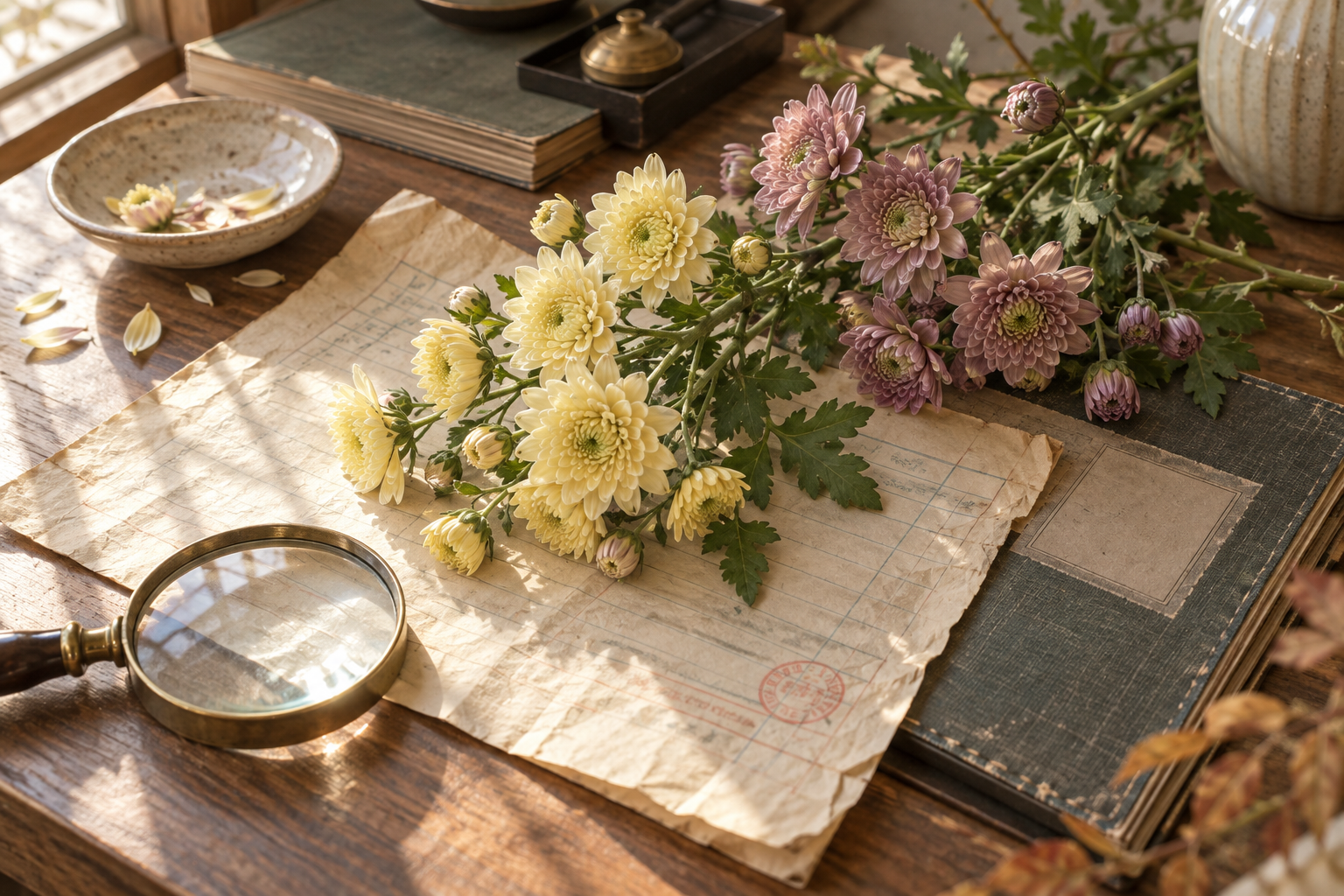
On the worktable stood a pale yellow spray chrysanthemum, a muted mauve spray chrysanthemum, and one stem of yellow solidago, which was not a chrysanthemum.
Kiku gave them no symbolic meanings. She explained only that standard and spray chrysanthemums present their flowers differently on the stem.
“You don’t have to choose from these, and it doesn’t have to be a chrysanthemum. Could you look at the garden and tell us what feels similar—and what feels different?”
The woman held the solidago for a while, then put it back. She lifted the pale yellow spray chrysanthemum and looked at it from the side.
“The flowers in Grandmother’s garden also faced every possible direction. This looks more like the garden than the funeral.”
She chose that one stem herself. She would cut it short for a white vessel and place it beside the small shears her grandmother had used.
Before wrapping the stem, Rose asked, “How would you like us to remember this stem in the record?”
The visitor thought before answering.
“Not a chrysanthemum for mourning. A chrysanthemum that takes me back to her garden.”
Kiku copied the sentence into the Flower Calendar without shortening a word.
After the visitor left, the three compared the old order slip with the market records. Joining the marks across the fold still did not justify one variety name. Statistical categories described distribution; they could not identify a single cultivar on an individual order.
“Then we leave this blank,” Rose said.
With a vermilion pencil, she wrote on a clean card:
Variety unconfirmed. Three candidate readings. Do not state one as fact until the original slip can be compared with the shop’s records.
For the first time that morning, Kiku sat down.
“That, I can verify.”
As they returned the documents, a flattened flower trace appeared near the binding of the old ledger. Almost all its color was gone. Nothing similar appeared in the shop’s handled-item list.
Gerbera held her breath.
“A different flower from the order?”
Kiku recorded only the size of the trace. She did not give it a name.
Rose offered no answer either.
Instead, she added a new field:
Who chose this stem?
The flower fact in this episode
From 1991 through 2008, Japan’s Ministry of Agriculture, Forestry and Fisheries counted cut chrysanthemums in three wholesale-market categories: standard, spray, and small-flowered types. These categories described market distribution. They did not identify every cultivar or represent the personal memories attached to a flower.
A useful sentence at a florist
“This is for a personal remembrance at home. I would like to compare forms different from large white chrysanthemums, including flowers that are not chrysanthemums, and choose one stem myself.”
The next clue
Who placed a flower trace not found in the shop’s handled-item records inside the thirty-year-old ledger?