Japan’s Ministry of Agriculture, Forestry and Fisheries published the first report of its Survey on Crop Production, “2025 Crop-Year Flower Planted (Harvested) Area and Shipments,” on June 30, 2026. The area used for cut flowers was 11,670 hectares and shipments totaled 2.679 billion stems; both indices were 94 when the previous crop year equals 100.
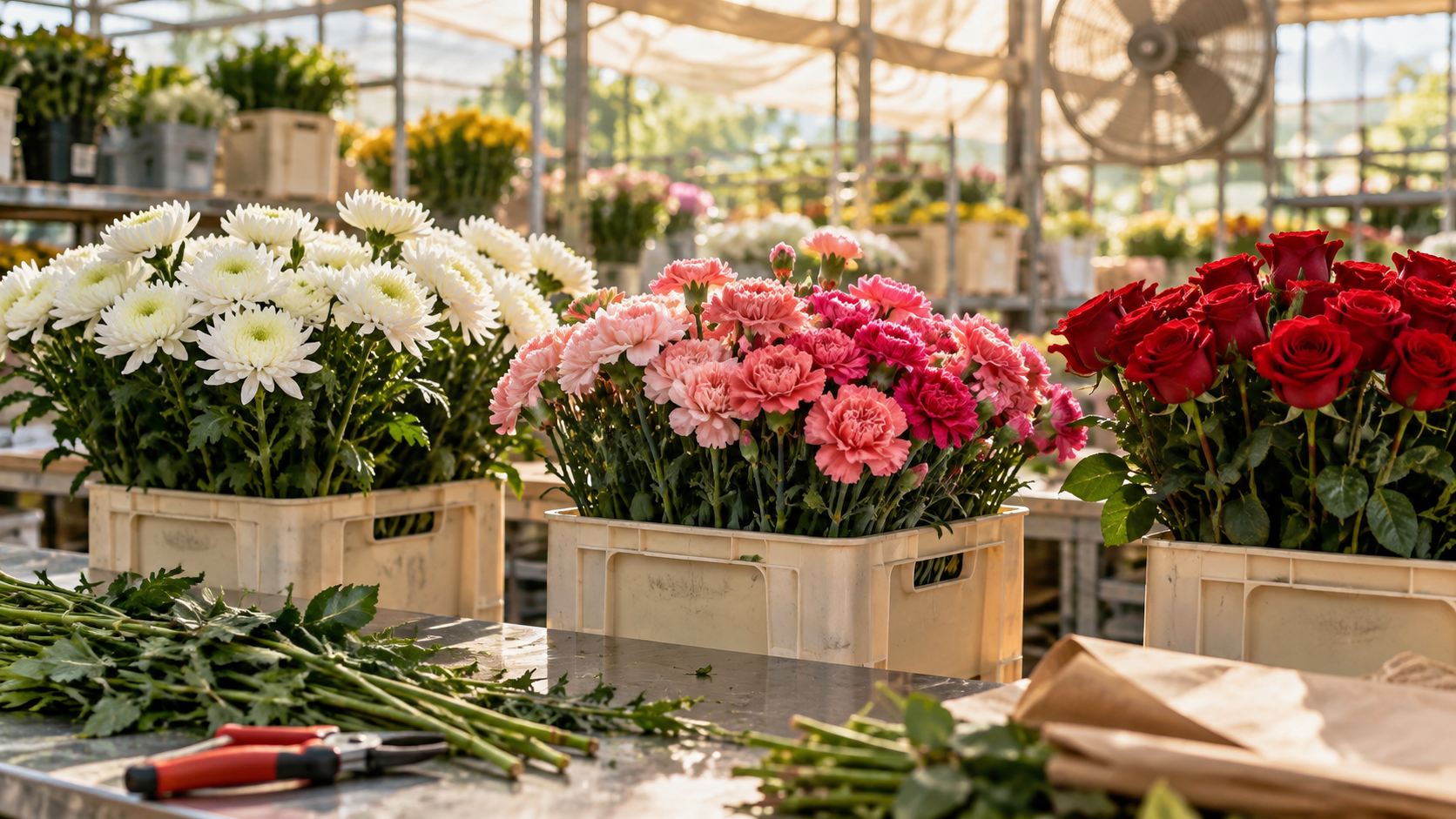
Editorial image representing cut-flower production and distribution. It does not depict a named market, farm, or the specific varieties covered by the statistics.
Shipment index (previous crop year = 100)
| Category | Shipments | Index |
|---|---|---|
| Cut flowers, total | 2.679 billion stems | 94 |
| Chrysanthemums | 1.046 billion stems | 94 |
| Carnations | 154.3 million stems | 90 |
| Roses | 148.5 million stems | 87 |
Bars start at zero and use the previous crop year as an index of 100. Source: Japan Ministry of Agriculture, Forestry and Fisheries, Survey on Crop Production, “2025 Crop-Year Flower Planted (Harvested) Area and Shipments” (First Report, published June 30, 2026).
Three major categories were also below the previous crop year
- Chrysanthemums: 3,520 hectares (index 92); 1.046 billion stems (index 94)
- Carnations: 197 hectares (index 92); 154.3 million stems (index 90)
- Roses: 229 hectares (index 90); 148.5 million stems (index 87)
A single year of data does not prove weaker demand. Production area, growing conditions, prices, and trade need to be examined separately.
What this release does and does not show
The first report lets readers compare planted area and shipments by category. It does not by itself establish how heat-mitigation measures, grower numbers, farm scale, imports, or prices affected the result. We will update this article if the final report revises the figures.