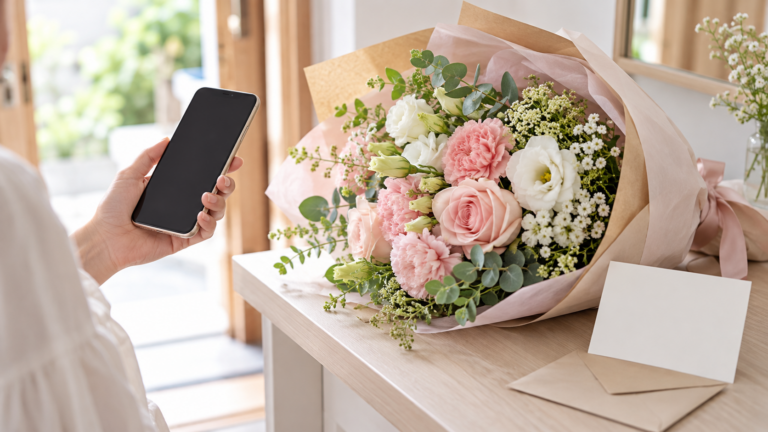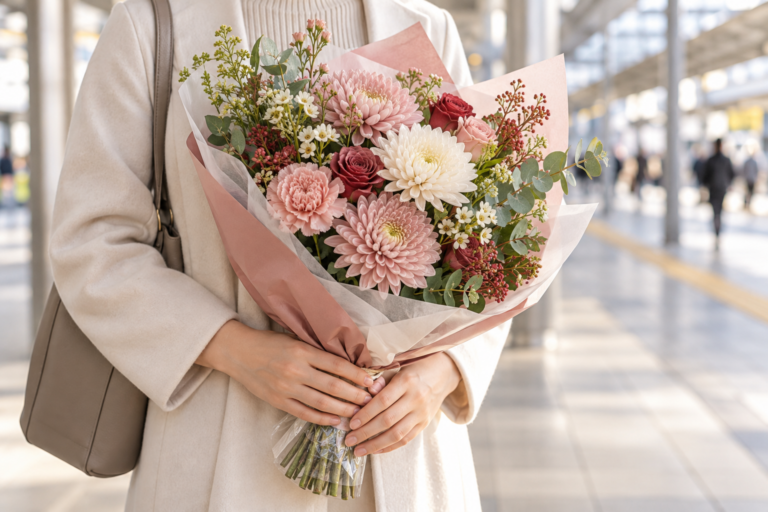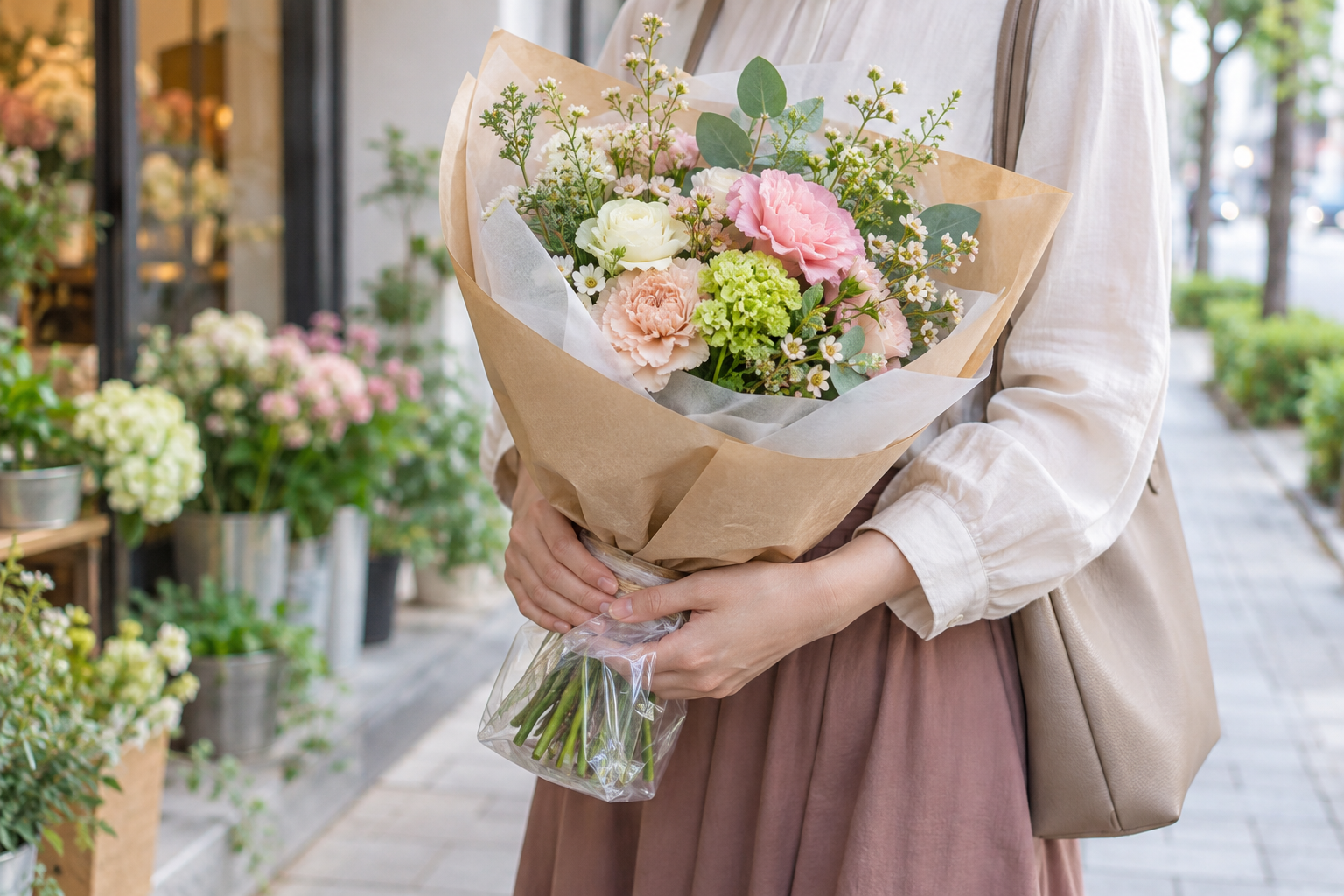
An editorial image illustrating bouquet transport. It does not depict a real person or florist.
A bouquet may be damaged between collection and delivery. Before the florist finishes it, explain when you will give it, how you will travel, and how long you will carry it. Guidance published by Japan’s Ministry of Agriculture, Forestry and Fisheries notes that this information helps a florist adjust water protection and bouquet size.
Give the florist three details
- Time until delivery: immediately or several hours later.
- Transport: walking, train, bicycle, or car.
- Temporary storage: whether a cool indoor place is available.
For a long trip, ask for a bouquet you can support safely rather than choosing size by appearance alone. In a crowded train, support it in front of your body without pressing flowers or foliage against luggage. If temporary storage is available, confirm that it is indoors, cool, and away from direct airflow.
Three rules during travel
- Avoid impact. Do not crush flowers or foliage against luggage.
- Keep it upright. Water can escape from the protected stem ends if the bouquet is inverted.
- Do not leave it in heat. Avoid parked cars and direct sun, while also keeping heating or cooling airflow off the flowers.
Remove flowers from a car first
Cut-flower quality is affected by temperature and time. MAFF also describes temperature control and pre-treatment with preservatives as important in the supply chain. Even during a short stop, do not leave a bouquet in a vehicle. Move it into a cooler indoor place as soon as you arrive.
If delivery is several hours away
Do not place the fully wrapped bouquet into water without checking the florist’s instructions. When the interval will be long, discuss it while ordering; collecting the bouquet later may be safer.
Sources: MAFF Chugoku-Shikoku Regional Agricultural Administration Office, Visiting a Florist; MAFF, How Flowers Reach Us