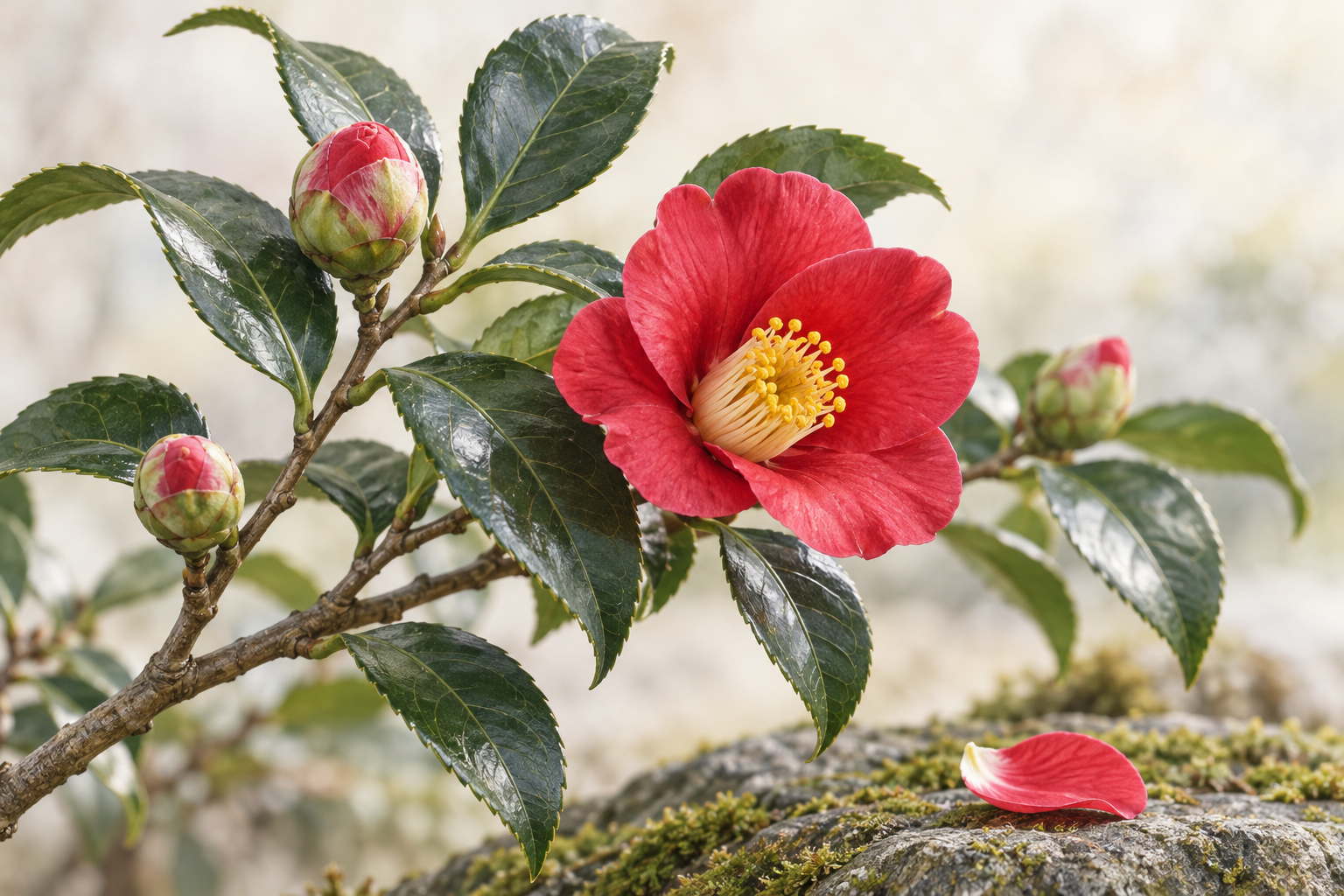
Camellias are woody plants valued for glossy evergreen foliage and flowers that appear from winter into spring. This guide does not treat every camellia as one species; it uses Camellia japonica as its taxonomic reference. Kew accepts that name and lists it as native to central and southern Japan, Taiwan, Jeju Island in South Korea, and Shandong and eastern Zhejiang in China.
Looking at the flower and leaves
Camellia japonica is an evergreen shrub or small tree with thick, glossy leaves. Cultivars vary widely in color and flower form, so the image on this page is not presented as the only way a camellia can look.
Growing in a garden or container
The Royal Horticultural Society recommends acidic, well-drained soil, partial shade, and shelter from cold winds and early-morning sun. Severe summer drying can contribute to bud and flower drop because the next season’s buds develop during that period. Check container plants for drying and restricted roots; prune after flowering when needed.
Displaying cut branches
Obtain permission before cutting from any garden tree and use clean, sharp tools. When buying a branch from a florist, ask how to recut it and how much water to use for its thickness and bud stage. At home, use a clean vessel, remove foliage below the waterline, and keep it away from direct sun and heated airflow.
Pet safety
The ASPCA lists Camellia japonica as non-toxic to dogs, cats, and horses. Non-toxic does not mean edible. Do not intentionally feed it to an animal, and contact a veterinarian if an animal becomes unwell after chewing it.
Giving a camellia
For a pot or large cut branch, confirm space, weight, and the recipient’s ability to care for it. Camellias carry varied historical and regional associations in Japan; do not present one flower-language claim or custom as a universal meaning. Add your own reason for choosing it.